Loading city...
Skip to main content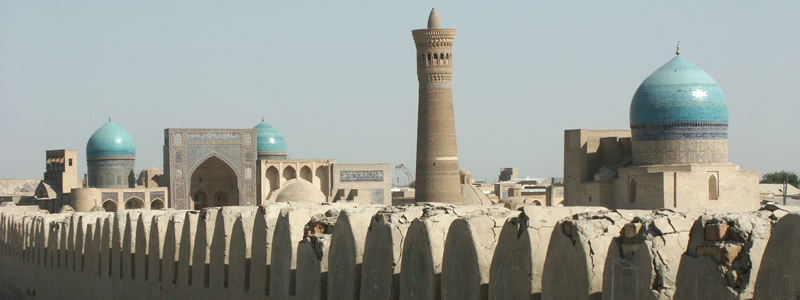 Plan a trip to Bukhara →
Sample plans for Bukhara:
Bukhara
30 places · 1 airports
30 places
🎯Bukhara Silk Carpet Workshop
Several traditional silk carpet workshops operate near Lyabi-Hauz, offering visitors the chance to watch artisans hand-weave the intricate Bukhara carpets that have been prized across the world for centuries. The workshops also produce natural silk using traditional dyeing methods.
culturetraditionalinteractive
45 minFree
🏘Bukhara Old City
Bukhara's historic centre is a UNESCO World Heritage Site encompassing over 140 architectural monuments spanning 10 centuries. The labyrinth of narrow alleys, covered bazaars, and courtyard houses between the Ark and Lyabi-Hauz forms one of the best-preserved medieval cityscapes in the Islamic world.
neighborhoodhistoryunesco
180 minFree
🏛Bukhara Gold-Embroidery Museum
The Bukhara Gold-Embroidery Museum is dedicated to the city's renowned zarduzi tradition — the art of gold-thread embroidery that decorated the robes of emirs, khans, and wealthy merchants. Live demonstrations let visitors watch artisans stitch intricate metallic designs.
museumculturetraditional
45 minUZS15000
⭐Ismail Samani Mausoleum
The Ismail Samani Mausoleum is Bukhara's oldest monument and a masterpiece of early Islamic architecture. Built entirely of baked bricks arranged in 18 different patterns, the cube-shaped tomb appears to change appearance as the sunlight shifts throughout the day.
architecturehistoryIconic
30 minUZS15000
⭐Ark of Bukhara
The Ark is a massive fortress in the northwest of Bukhara that served as the seat of power for the Emirs of Bukhara for over a millennium. The complex houses museums, throne rooms, and the remains of royal quarters within its imposing 20-meter-high mudbrick walls.
CastlehistoryIconic
90 minUZS60000
🏛Bukhara State Architectural Art Museum
The Bukhara State Architectural Art Museum occupies several halls within the Ark fortress, displaying archaeological finds, Islamic manuscripts, historical photographs, and art that traces Bukhara's 2,500-year history.
museumhistoryarchaeology
60 minUZS25000
🌳Samanid Park
Samanid Park is Bukhara's main urban green space, surrounding the Ismail Samani Mausoleum. With shaded walkways under mature trees, a small amusement park, and open-air tea stands, it provides a relaxing escape from the dense historic centre.
parkrelaxingFamily Friendly
45 minFree
⭐Bahauddin Naqshband Mausoleum
The Bahauddin Naqshband Mausoleum complex, located 12 km southeast of Bukhara, is one of the most important pilgrimage sites in Central Asia. It honors the 14th-century Sufi mystic who founded the Naqshbandi order, one of the most influential Sufi brotherhoods in the Islamic world.
Religioushistorypeaceful
60 minFree
⭐Kalyan Mosque
The Kalyan Mosque (Masjid-i Kalyan) is the main Friday mosque of Bukhara, a vast congregational space that can hold 10,000 worshippers. Built at the foot of the Kalyan Minaret, it is one of the largest mosques in Central Asia, with an immense courtyard surrounded by 208 columns and 288 domes.
Religiousarchitecturehistory
45 minUZS25000
👁Poi Kalyan Ensemble
The Poi Kalyan ('At the Foot of the Great') ensemble is Bukhara's most iconic architectural composition — the soaring Kalyan Minaret flanked by the Kalyan Mosque and Mir-i-Arab Madrasa. The plaza between them offers the most photographed view in all of Uzbekistan.
viewpointIconicphoto op
30 minFree
⭐Kalyan Minaret
The Kalyan Minaret is the defining symbol of Bukhara, a 47-meter tower of baked brick that has dominated the city's skyline since 1127. Known as the 'Tower of Death' for its use as an execution site in the 19th century, it is one of the most remarkable examples of medieval Islamic architecture in Central Asia.
Iconichistoryarchitecture
30 minFree
🏛Magoki-Attori Mosque
Magoki-Attori is one of Bukhara's most archaeologically significant monuments — a 12th-century mosque built six meters below modern street level on the site of a pre-Islamic Zoroastrian temple and Buddhist stupa. It now houses the Bukhara Carpet Museum.
museumhistoryarchitecture
30 minUZS15000
⭐Kukeldash Madrasa
Kukeldash Madrasa is the largest madrasa at Lyabi-Hauz and one of the biggest in Central Asia. Built in 1568, it forms the northern boundary of the ensemble and offers rooftop views over the old city.
architecturehistoryFree Entry
20 minFree
🏛Chashma-Ayub Mausoleum
Chashma-Ayub ('Spring of Job') is a medieval mausoleum and sacred spring, now housing the Bukhara Water Museum. Its distinctive conical Khorezmian-style dome makes it stand out among Bukhara's monuments. According to legend, the prophet Job struck his staff on this spot and water sprang forth.
historyarchitectureReligious
30 minUZS15000
🏛Sitorai Mokhi-Khosa Palace
Sitorai Mokhi-Khosa ('Star and Moon Palace') was the summer residence of the last Emir of Bukhara, located 4 km north of the city centre. This eccentric palace blends Russian Art Nouveau and Central Asian Islamic architecture in a surprising hybrid style.
historyarchitectureGarden
90 minUZS25000
⭐Chor-Bakr Necropolis
Chor-Bakr ('Four Brothers') is a haunting 16th-century necropolis 5 km west of Bukhara, built as a 'city of the dead' around the tomb of Abu Bakr Sa'ad, a descendant of the Prophet Muhammad. The complex includes mosques, madrasas, and family tombs in an eerily quiet setting.
historyReligiousHidden Gem
60 minUZS15000
⭐Bolo Hauz Mosque
Bolo Hauz Mosque stands opposite the Ark fortress, notable for its extraordinary wooden iwan (porch) supported by twenty intricately carved and painted wooden columns. The mosque was the personal place of worship for the Emirs of Bukhara.
Religiousarchitecturehistory
20 minFree
🏛Bukhara Museum of Fine Arts
The Bukhara Museum of Fine Arts occupies a converted former Russian-era bank building and displays Uzbek fine art alongside decorative arts, suzani textiles, and Bukhara's famous gold-embroidered robes.
museumartculture
45 minUZS15000
⭐Nadir Divan-Begi Madrasa
Nadir Divan-Begi Madrasa anchors the eastern side of Lyabi-Hauz and is instantly recognizable by its entrance mosaic depicting two phoenixes carrying deer toward a human-faced sun — a remarkably figurative image for Islamic architecture.
architecturearthistory
30 minUZS15000
⭐Abdulaziz Khan Madrasa
The Abdulaziz Khan Madrasa (1652) faces the Ulughbek Madrasa, and the contrast between the two is striking. While Ulughbek's building is austere, Abdulaziz's is exuberantly decorated with the finest tilework and painted ceilings in Bukhara, representing the peak of Bukharan decorative art.
architecturearthistory
30 minUZS15000
Getting There
AIR
Bukhara International Airport
BHK
Notice any incorrect information? Let us know →